Monday, 23 September 2013

The Hollywood Formula

Christina Klein (2004, p. 361)describes Hollywoodisation somewhat bleakly, saying that “global Hollywood is gobbling up a seemingly ever-increasing share of the world’s film markets and in doing so is driving local industries to the brink of collapse and homogenizing the world’s film culture.” This is directly seen in the way that Asian films have taken on various tropes of Hollywood films, not excluding the happy ending or the good-looking hero.


'Pride and Prejudice', starring Keira Knightley, is an example of a non-American film that has been Hollywoodised. Deborah Cartmell (2010, p. 12) states how this “major film uses celebrity status in the form of Keira Knightley as Elizabeth, and, to a lesser extent, Judi Dench as Lady Catherine, to draw in the crowds.” Another Hollywoodisation is the use of a 21st century American ideal of beauty, with several of the main actresses, but in particular Keira Knightley, being too thin for the idea of 18th or 19th century beauty.
Cowen discusses globalisation in terms of “increased cross-cultural exchange, expanded consumer preferences and greater aesthetic diversity” (cited in Klein 2004, p. 361), painting this concept of globalisation—and also, Hollywoodisation—in a more positive light. Whether a good or bad thing, it’s safe to say that cinema cultures are being watered down through denationalisation.

The audience for Hollywood films has shifted in the last decade, and Frederick Wasser (1995, p. 42) says, “On a per capita basis the American viewer is of no more importance [than] any other member of the global audience” (p. 424)—showing that a significant proportion of the viewers are now from other countries. While almost all  blockbusters and the majority of big-name films are still produced in California, their success no longer hinges solely on the American, or even Western, market.

Wasser (1995, p. 428) says that, “Pictures had to be targeted to a market, not to a nation. Distributors tried to appeal to different demographic groups, in particular, youth.” This shows the move toward a different way for the media to market new films, and how they had to employ a sense of hybridity to appeal to a wider audience.
In 2013, advertising companies are being pushed to find newer, better and more diverse ways of presenting a film because the idea of a success or blockbuster is being driven to new heights.


References:

Image: Boyle, L 2011, ‘Jane Austen’, retrieved 24 September 2013, <http://www.janeausten.co.uk/pride-and-prejudice-an-overview/>.

2013, ‘IMBD’, retrieved 24 September 2013, <http://www.imdb.com/title/tt0414387/>.

Cartmell, D 2010, Screen Adaptations, Methuen Drama, retrieved 23 September 2013, <http://reader.eblib.com.au.ezproxy-m.deakin.edu.au/(S(ixvfrav1rojvloal5lkxz0e3))/Reader.aspx?p=692120&o=154&u=GPIwEjgV9b6sgJqdjUr%2f3g%3d%3d&t=1379940038&h=4FDE417D1234B650ED30802898AA88E5F91EE1D8&s=10127409&ut=484&pg=1&r=img&c=-1&pat=n#>.

Farlex, 2013, ‘The Free Dictionary’, retrieved 24 September 2013, <http://www.thefreedictionary.com/denationalization>.

Klein, C 2004, ‘Martial arts and globalisation of US and Asian film industries’, Comparative America Studies, vol. 2, no. 3, pp. 360-384.

Waller, G A 2013, ‘Senses of Success and the Rise of the Blockbuster’, Film History, vol. 25, no. 1/2 , pp. 11-18, retrieved 24 September 2013, <http://ehis.ebscohost.com/ehost/pdfviewer/pdfviewer?sid=449e593d-ec9d-4dc4-9ece-a765583c2b07%40sessionmgr110&vid=2&hid=101>.  

Wasser, F 1995, ‘Is Hollywood America? The Trans-nationalization of the American Film Industry’, Critical Studies in Mass Communication, vol. 12, pp. 423-437.


Wednesday, 18 September 2013

Miley 2.0


The media is a giant fishbowl. With the effects of globalisation only increasing, everything is becoming more magnified, more watched, more pressured. Miley Cyrus is an example of someone who the media has recently gotten to.

According to Robertson, “Globalisation as a concept refers both to the compression of the world and the intensification of the world as a whole (cited in Rantanen 2005, p. 7). Media certainly serves as an intensifier—whether it be of fame, popularity or infamy.

David Marshall (2010, p. 499) describes the specular economy as the “new reconstruction of how the self is reconstituted through the screens of engagement and interactivity that serve to organize and shape our lives.” Many would agree that today we basically have no choice but to participate in the specular economy. Without major social media sites like Twitter and Facebook, you can easily find yourself cut off from the rest of the world or, in a word, excluded. For example, there are several Apps that you can’t use unless you have a Facebook account.

We have moved from representational media, where things were shown more or less as they were, to presentational media, where individuals (celebrities and everyday people alike) now construct their ‘persona’ that they want to present to the world. This is all largely done through social media.

Miley Cyrus has recently done a series of shocking publicity stunts in an effort to prove to people that she’s no longer the Hannah Montana role model—apparently still holding to the adage “any publicity is good publicity”. First there was the music video to her single ‘We Can’t Stop’, then the teddy bears from the video reappeared at the VMAs where Miley delivered her now incredibly famous performance with Robin Thicke and the notorious foam finger.


Is all this just an effort to say to the world, “I’m not a little girl anymore”? Where is the line? Interestingly, now with the media door swinging both ways, considerable backlash has surfaced on social media fronts.

David Marshall (2010, p. 499) says, “The use of social network sites such as Facebook, Twitter, MySpace, Bebo, and MiniHompy, along with parallel media-specific sharing websites such as YouTube and Flickr, means that we are inhabiting spaces where we are not only on display but we think about our mediated construction of ourselves sometimes continuously.” 

Has this self-obsession with our public image or ‘persona’ been the cause of stunts like Miley’s? We tend to blame the individual person, like Miley, but is it the whole of society that’s actually to blame?


References:

Image 1:   Alman, C 2013, ‘Miley Cyrus’ raunchy performance at the VMAs’, Beauty Heaven, 27 August, retrieved 18 September 2013, <http://www.beautyheaven.com.au/celebrity/celebrity-news/miley-cyrus-vma-performance-11547>.

Arbeiter, M 2013, ‘2013 MTV VMAS: Miley Cyrus Pioneers the Movement to Sexualise Teddy Bears’, Hollywood, 25 August, retrieved 18 September 2013, <http://www.hollywood.com/news/celebrities/55027338/miley-cyrus-teddy-bears-2013-mtv-vmas?page=all>.

Mashall, P D 2010, ‘The Specular Economy’, Society, vol. 47, no. 6, pp. 498-502.
Rantanen, T 2005, ‘Theorizing Media and Globalization’, The Media and Globalization, Sage, London, pp. 1-18.

Twitter 2013, ‘Twitter’, retrieved 18 September 2013, <https://twitter.com/search?q=miley%20cyrus%20vmas&src=rela>.

Vevo, 2013, ‘YouTube’, retrieved 18 September 2013, <http://www.youtube.com/watch?v=LrUvu1mlWco>.


Wednesday, 11 September 2013

Trivialising the Trope

According to Thompson, “Globalization . . . refers to the growing interconnectedness of different parts of the world, a process which gives rise to complex forms of interaction and interdependency” (cited in Rantanen 2005, p. 7). Video games benefit from the “growing interconnectedness” because of the ability for people from different countries to play each other over the internet.

This week in our tutorial, as a response to part one of 'Damsel in Distress: Tropes vs. Women in Video Games' by Anita Sarkeesian we drafted the concept for a video game that subverted the 'damsel in distress' trope. Our action-adventure game is titled Indiana, about a girl rising to the challenge of rescuing herself in a Wild West setting. Because the whole point was to be subversive, we decided to give the main character, Indiana, a gender-neutral name and have her kidnapped in the first scene by an outlaw (making it seem like every other video game).

Her male counterpart sets out on a stereotypical quest in order to save her, but instead the game flashes back to an appropriately dressed Indiana (in order to subvert the ‘female as prize to be won’ trope), who frees herself and embarks on a quest of her own.

Raessens (2010, p. 379) says that “interactivity . . . can be defined as the possibility for the player to take up the role of narrator and influence the course of events and actions, possibly as a character in the plot.” Indiana as a game promotes interactivity by allowing gamers as the character Indiana to a large extent create their own adventure.

Raessens (2010, p. 381) also describes reconfiguration as being able to “control the transformation of a body of information to meets its needs and interests.” Indiana meets the needs and interests of a wide audience, having the violence and action for guys, while a female protagonist will attract more girls to the game.

Her cowboy comes back at the end to rescue her, but finds that she’s already escaped. Both of them then fight the evil outlaw because Indiana has stolen his gold (the object of the cowboy’s quest).
The game will be compatible with an Xbox and PS3 platform, with a realistic render art style, similar to that of  Read Dead Redemption, as pictured below.


References:

Image 1: Reith, G 2010, ‘Gaming Bolt’, retrieved 11 September 2013, <http://gamingbolt.com/red-dead-redemption-reviewed>.


Rantanen, T 2005, ‘Theorizing Media and Globalization’, The Media and Globalization, Sage, London, pp. 1-18.

Raessens, J 2005, ‘Computer games as participatory media culture’, Handbook of Computer Game Studies, MIT Press, Cambridge, pp. 373-388.

Sarkeesian, A 2013, 'YouTube', retrieved 11 September 2013, <https://www.youtube.com/watch?v=toa_vH6xGqs>.

Rockstar Games 2013, 'Red Dead Redemption', retrieved 11 September 2013, <http://www.rockstargames.com/reddeadredemption/>.

Wednesday, 4 September 2013

Microblogging: the latest political dynamite

Politicians are always looking for a new way to campaign; the latest strategy to get through to the most people possible. The blogosphere has always been an effective place to disseminate information on a wide scale and now politicians have taken microblogging by storm. Orlorf Larsson and Moe say, “Twitter is often understood as a derivative or miniature version of the regular blog” (p. 730). The 140-character limit makes the information accessible and users can read several tweets in the blink of an eye.

Globalisation, as defined by Albrow, “refers to all those processes by which the peoples of the world are incorporated into a single world society, global society” (cited in Rantanen 2005, p. 7). This global society, or global village, as it is known, allows the flow of information over a wide forum.

Technology, an integral aspect of globalisation, has brought the world closer. As Gibson says, “technology is often viewed as a key driver of change in the electoral arena” (cited in Olorf Larsson & Moe 2011, p. 731). The political party who employs the most sophisticated technology undoubtedly has the edge.


Twitter is the ‘latest and greatest’ way for politicians to get their message out to the people. Campaigning has gone wild, with social media playing a huge part in the voice of the people. Parties and statisticians are now also more easily able to predict the outcome of an election.

Social media has bred a generation that are obsessed with ‘updating’ all of their cyber friends on their every move. This means that people are now more open about who they are voting for. With so much of the population giving an indication of who they are going to vote for before election day, it inevitably changes the whole campaign.

Social media has gained respect in recent years, with a survey by George Washington University and Cision in 2009 revealing that 52 per cent of journalists “used Twitter for online research” (cited in Small 2011, p. 873). Scholar Jewitt also says that “Twitter can be a source of breaking news because it is ‘a real time global communications platform” (cited in Small 2011, p. 873).

Politicians can see how good their polls are and react accordingly—all products of globalisation and increased communication.

Using a social media site like Twitter enables politicians to access a totally new demographic. It is no doubt an advantage to be able to influence the fresh-faced 18-year-olds of the country who don’t have a whole horde of baggage concerning the political parties.

Study about social media affecting thoughts and decisions of (esp. young) people. Because our young people are so influenced by what people the media presents to them, hegemony is used by politicians to instil their own ideology into people’s minds.


References:

Image: Media Bistro 2013, ‘All Twitter’, retrieved 4 September 2013, <http://www.mediabistro.com/alltwitter/chirpify-political-fundraising_b24602>.

ABC 2013, ‘Federal Election 2013’, retrieved 4 September 2013, <http://www.abc.net.au/news/federal-election-2013/opinion-polls/?WT.srch=1&WT.mc_id=Corp_News-Elections-Federal-2013_AdWords_:election%20polls_e_g_33167047759_&gclid=CJj04q6vsbkCFcrGpAodFTUAAA>.

Olorf Larsson, A & Moe, H 2011, ‘Studying political microblogging: Twitter users in the 2010 Swedish election campaign,’ New Media and Society, vol. 14, no. 5, pp. 729-747.

Rantanen, T 2005, ‘Theorizing Media and Globalization’, The Media and Globalization, Sage, London, pp. 1-18.

Small, T A 2011, ‘What the hashtag?’, Information, Communication & Society, vol. 14, no. 6, pp. 872-895, retrieved 4 September 2013, <http://www.tandfonline.com/doi/pdf/10.1080/1369118X.2011.554572>.


Twitter 2013, ‘Twitter’, retrieved 4 September 2013, <https://twitter.com/search?q=Australianelection&mode=relevance&src=typd>.

Wednesday, 28 August 2013

Capitalism, Prosumption and Exploitation


With the rise of capitalism and the strong influence of Americanisation on our modern world, we see that the rich do indeed ‘get richer’ while the poor become increasingly victimised.

Globalisation, as defined by Albrow (cited in Rantanen 2005, p. 7) “refers to all those processes by which the peoples of the world are incorporated into a single world society, global society.”

This being said, has globalisation made an improved world society? The victims of trade exploitation would I think say not. With all our advances in technology, our global village seems to have taken a moral dive.

Ritzer and Jurgenson describe the world as being “dominated by capitalism” (Ritzer & Jurgenson 2010, p. 13) and it can be suggested that this social structure still serves our ‘fat cats’—at the expense of the dregs of society.

Just as the internet is exploding with citizen journalism and people starting businesses from home, prosumption is also accelerating. Karl Marx has been known to acknowledge that, “although he fully understood that production always involved consumption (and vice versa), [he] clearly believed that it was production that was pre-eminent in the capitalism of his day” (Ritzer & Jurgenson 2010, p. 14).

Consumption and production used to be two separate entities, with producers and their target buyers clearly defined. Now, with constant international trade going on through facilitators like eBay and Amazon, prosumption is threatening to take over—and has already significantly decreased—traditional trade. Globalisation is demanding more products at a lower price.


This phenomenon, known as McDonaldisation, is making everything bow to Western culture.

Oxfam and other non-for-profit fair trade unions are working stop the exploitation, but capitalism, largely thanks to globalisation, the fight is indeed fierce.


Places like Wal-Mart, which Ritzer and Jurgenson refer to as “America’s cathedrals of consumption”(Ritzer & Jurgenson 2010, p. 16) are companies financially backing this industry of exploitation—whether intentionally or not. Americanisation promotes lower prices in department stores, which pressures people in countries like China to work for smaller and smaller salaries—with the threat of unemployment looming over them if they refuse.

Is prosumption the inevitable evolution of a ‘civilised’, capitalist society, or is it proof of our human tendency to exploit the weaknesses of others? Is it really building a mutually beneficial society, or a prison that traps those born into poverty?


References:

Images:
Image 1: Made in China Pic: React, 2013, ‘Africa News’, retrieved 29 August 2013, <http://www.africanews.com/site/list_message/21890>.
Image 2: ‘Oxfam Australia’ retrieved 29 August 2013, <https://www.oxfam.org.au/2011/07/zara-european-brands-exploit-workers-in-bangladesh/>.
Image 3: Boycott China Picture: Madden, C 2013, ‘Chris Madden Cartoons’, retrieved 29 August 2013, <http://www.chrismadden.co.uk/cartoon-gallery/cartoon-boycott-products-made-in-china/>.

2013, ‘China’s workers demand a better trade union’, Child Labour Bulletin, 22 March, retrieved 29 August 2013, <http://www.clb.org.hk/en/content/china%E2%80%99s-workers-demand-better-trade-union>.

‘Amazon’, retrieved 29 August 2013, <http://www.amazon.com/>.

Beiter, G 2006, ‘Global capitalism fueling poverty and immigration’, Socialistworld.net, 5 January, retrieved 29 August 2013, <http://www.socialistworld.net/doc/2255>.

Crabb, A 2012, ‘Americanisation of everything, even Crikey’, Crikey, 8 November, retrieved 29 August 2013, <http://www.crikey.com.au/2012/11/08/americanisation-of-everything-even-crikey/>.

‘Ebay’, retrieved 29 August 2013, <http://www.ebay.com.au/>.    
   
‘Globalisation’, retrieved 29 August 2013, <http://globalisationmaxmulholland.weebly.com/americanisation.html>.

Keel, R 2010, ‘The McDonaldizaton of Society’, Introduction to Sociology, 7 July, retrieved 29 August 2013, <http://www.umsl.edu/~keelr/010/mcdonsoc.html>.

‘Oxfam Australia’ retrieved 29 August 2013, <https://www.oxfam.org.au/2011/07/zara-european-brands-exploit-workers-in-bangladesh/>.

Rantanen, T 2005, ‘Theorizing Media and Globalization’, The Media and Globalization, Sage, London, pp. 1-18.

Ritzer, G, Jurgenson, N 2010, ‘Production, Consumption, Prosumption: The nature of capitalism in the age of the digital “prosumer”’, Journal of Consumer Culture.

Toffler, A 2010, ‘YouTube’, retrieved 29 August 2013, <http://www.youtube.com/watch?v=lqsGfF7iLSw>.


Tuesday, 20 August 2013

The Recycle of Fashion

We live in a remixed world where the question constantly looms in the back of our minds: is anything original? Is it possible to create something new, or is everything just a rehash of what we've previously consumed?

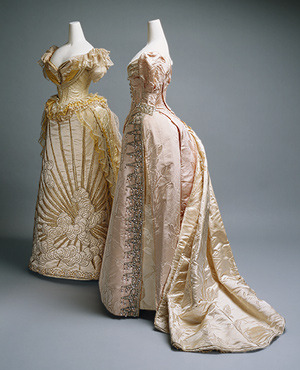
Because of globalisation, the flow of information is so rampant that copying and remixing is only increasing. Take fashion, for instance. New and amateur designers, thanks to technology and widely published books, now have access to all the fashion records of most major countries throughout history.

If an up-and-coming designer goes onto the internet and Google searches a 1800s  wedding gown style,
have they plagiarise the designs of that era when they present a slightly modified version of them to a company or is it simply just a remix?

As file-sharing and the music industry have shown us, intellectual property rights is such a slippery-slope these days, especially for those who would claim that the law is wrong, like some in the file-sharing community do.

In their article Sharing Music Files: Tactics of a challenge to the industry, scholars Martin, Moore and Salter support this, saying, “In analysing the controversy over file–sharing, it is important to note that what counts as injustice — or unfairness, inappropriate behaviour, or any other negative label — varies from person to person” (Martin, Moore & Salter 2010).

The middle road between inspiration and plagiarism is the remix. As with adaptation, you acknowledge the original source when ‘remixing’ an idea, but don’t reference your source officially, especially in areas like fashion.

B Martin, C Moore and C Salter also discuss cover-up as one of the main tactics to get away with stealing other people’s ideas. They say, “This cover–up is selective: within the file–sharing community, downloads can be carried out openly, whereas secrecy and disguise are more likely to be used in relation to outsiders” (Martin, Moore & Salter 2010). This could mean that amateur designers share their sources, but present the idea as original when marketing it to people.


It is commonly acknowledged that fashion moves in cycles, and while evolving somewhat, a lot of the styles are rehashed. As seen in the pictures above, clothing that used to be worn for practical reasons, like overalls, are now being showcased as fashion items. Also hundreds of years ago, tights were part of a typical gentleman’s dress, but now although supposedly obsolete, tights have resurfaced for boys in the form of ‘skins’ used for sports. Styles may be advertised as the ‘latest thing’, but in many cases an original form of that style can be found in fashion centuries ago.

Can we conclude then that although the ingredients we use to create something are the culmination or direct result of things we've consumed, that our end result is certainly personal to us, if not completely original?


References:

Picture 1: ‘Clash Daily’, retrieved 20 August 2013, <http://clashdaily.com/2013/04/opportunity-is-missed-by-most-people-because-it-is-dressed-in-overalls-and-looks-like-work-thomas-edison/>.

Picture 2: ‘Become Gorgeous’, retrieved 20 August 2013, <http://www.becomegorgeous.com/fashion-style/new_trends/2010_fashion_trends__overalls-2119.html>.

Ferguson, K 2011, ‘Vimeo’, retrieved 21 August 2013, <http://vimeo.com/14912890>.

‘Heritage Gown’, retrieved 20 August 2013, <http://www.heritagegown.com/image/Bustle.jpg>.

Martin, B, Moore, C & Salter, C 2010, ‘Sharing music files: tactics of a challenge to the industry’, First Monday, vol. 15, no. 12.

‘Tumblr’, retrieved 20 August 2013, <http://31.media.tumblr.com/tumblr_lrz6p4Xrwk1r3dyz9o1_400.jpg>.

White, K 2012, 'Globalization and its impact on the Fashion Industry', retrieved 21 August 2013, <http://whiteunt01.wordpress.com/2012/02/02/globalization-and-its-impact-on-the-fashion-industry/>.


Wednesday, 7 August 2013

The Explosion of Language

Language used to be a slowly evolving thing—a mass lazily floating along, gathering a word here, a phrase there. But today the evolution of language could more easily be compared to a high speed train creating an air vacuum along the track it travels.

Hatchen and Scotton describe globalisation as “a profound interchange of cultures—a communication revolution” (Hatchen & Scotton 2002, p. 3) which directly relates to how words and phrases are being revolutionised in our postmodern world. Modernity tells us to embrace change and creativity, which must then include text talk.

Almost all of this is thanks to the internet, and a direct product of globalisation. Pieterse Nederveen says in his article Globalisation: Consensus and Controversies that “globalisation is being shaped by technological change” (Nederveen 2004, p. 9). This is shown through the fact that despite slang’s long history in the English language, text talk has now made the phenomena explode.

New words often used to be attributed to particular people, like Shakespeare. Now, with the flow of information picking up speed with incredible force, it’s almost impossible to trace who invented which word or phrase. The best that we can do to keep up is the Urban Dictionary, a publication documenting new colloquial words and sayings as they evolve.

Hatchen and Scotton say that “the media flow of information and news throughout the globe will have a greater impact than education on the world’s ability to understand its problems and dangers” (Hatchen & Scotton 2002, p. 7), meaning that text talk’s main medium (social media) is integral to globalisation’s hegemony.

As the internet makes new trends go viral, protecting intellectual property rights is an ongoing struggle and copyright laws are continually changing to accommodate the accelerated growth of technology.  Text talk phrases—popular acronyms like LOL and ROFL—spread like wildfire and new trends are hard to contain or track.


Globalisation in theory should be about enhancing and improving communication, but as the picture above illustrates, excessive use of slang and text talk actually sometimes inhibits communication. Colloquial lingo further alienates certain groups because there is only a certain amount of the population who can understand them.

Nederveen again comments on communication, saying that "a thread that runs through all globalisation episodes and discourses is increasing connectivity” (Nederveen 2004, p. 9). While this is technically true, has this so-called connectivity actually improved our ability to transmit information to each other?


References:

Image 1: Hunsdale Talbot, D 2011, ‘Book Reviews & the Written Word’, retrieved 7 August 2013, <http://www.writtenword.com/wp-content/uploads/2011/02/slang.jpg>.


Lady Luck Enterprises, 1998-2013, ‘All Down Under’, retrieved 7 August 2013, <http://alldownunder.com/australian-slang/>.

Mabillard, A 1999-2011, ‘Words Shakespeare Invented’, retrieved 7 August 2013, <http://www.shakespeare-online.com/biography/wordsinvented.html>.

Nederveen Pietrse, J 2004, ‘Globalization: consensus and controversies’, Globalization and culture: global melange, Rowan & Littlefield, pp.7-21.

Net Lingo, 1994-2013, ‘Net Lingo’, retrieved 7 August 2013, <http://www.netlingo.com/acronyms.php>.


Urban Dictionary, 1999-2013, ‘Urban Dictionary’, retrieved 7 August 2013, <http://www.urbandictionary.com/>.